Commercial roofing for Valley businesses and properties
Flat and low-slope roofs on commercial buildings take the full force of Arizona sun. We repair, maintain, recoat and replace them so your business stays dry and running.
Last updated

The short answer
Integrity Roofing provides commercial roof inspections, repairs, preventive maintenance, foam roofing, elastomeric coatings and roof replacement for offices, retail centers, industrial buildings, churches and multi-family properties throughout the Phoenix Valley.
Commercial roofing services
Most commercial buildings in the Valley have flat or low-slope roofs, such as spray foam, modified bitumen or coated systems, plus HVAC units and lots of penetrations. Those details are where leaks start.
- Commercial roof inspections and condition reports
- Leak repair and drain/scupper repairs
- Spray polyurethane foam roofing and recoating
- Elastomeric and reflective roof coatings
- Preventive maintenance programs
- Commercial roof replacement
- Multi-family and HOA roofing

Planned maintenance saves budgets
For property managers, unplanned leaks mean tenant complaints and damaged inventory. Regular inspections and scheduled recoating spread costs out, extend the roof's life, and help you plan capital expenses instead of reacting to emergencies.
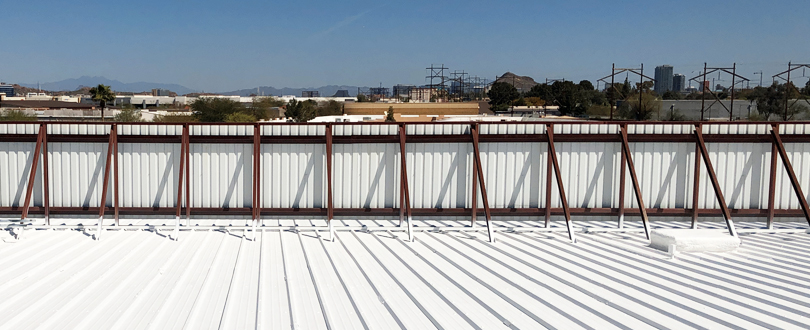
Drainage is where most flat roofs fail
Flat roofs aren't perfectly flat; they rely on slight slope, drains and scuppers to move water off. When debris clogs a drain or the roof settles, water sits. Standing water two days after rain, often called ponding, wears coatings faster, adds weight and finds its way into seams.
Keeping drains and scuppers clear, especially before and during monsoon season (June 15–September 30), is one of the simplest ways to protect a commercial roof. Where ponding keeps returning, we'll talk with you about options to improve drainage.
Coat, recoat or replace?
Many commercial roofs can be extended rather than replaced. If the roof is structurally sound and mostly dry, a foam recoat or an elastomeric coating can renew the surface and reflect sunlight. If water has soaked large areas of the roof, or the system is past repair, replacement is the better investment.
We inspect the roof, check for wet areas and wear, and explain which path makes sense. For pricing factors, see our roofing cost guide. Every roof is different, so your estimate is based on your building.
Working around tenants and operations
Commercial work affects more people than a home project. We'll coordinate the schedule with you, confirm how we'll reach the roof (exterior ladder, roof hatch or interior access), and plan where materials and equipment will go so entrances and parking stay usable.
It helps to let tenants know when work is scheduled, especially for jobs that involve noise or odor from coatings near HVAC intakes. Clear communication up front prevents most complaints.
What a commercial roof inspection covers
A commercial inspection looks at the whole roof system and the equipment on it:
- Roof surface: coating wear, blisters, cracks and punctures
- Seams, edges and parapet walls
- Drains, scuppers and areas of ponding
- Flashing around HVAC units, curbs, vents and skylights
- Signs of foot-traffic damage near equipment
- Photos and a written summary to support maintenance planning
How to reach us
Property managers and building owners can call our Gilbert office at 602-548-3770, Monday to Friday, 7 am to 5 pm. If we don't answer, leave a message and we'll return your call within 24 hours.
Tell us the building type, the approximate roof size and any active leaks, and we'll schedule an inspection.
What to expect
- 1
Inspection & estimate
We inspect the roof, photograph what we find, and give you a clear estimate for repair or replacement.
- 2
Scheduling
Once you approve, we coordinate materials and schedule the job around you.
- 3
The work
Our crew completes the repair or replacement to manufacturer and code requirements.
- 4
Quality check
We manage the project to completion and do a final quality-control walkthrough.
Commercial roof systems

Spray Foam Roofing
Our featured system: seamless, insulating, renewable roofs.
Learn more
Foam Roofing
Seamless, insulating flat roofs: install, repair, recoat.
Learn more
Elastomeric Coatings
Reflective, waterproof coatings for flat roofs.
Learn more
Flat Roofing
Low-slope roofs on homes, patios and businesses.
Learn moreFrequently asked questions
Still have a question? Call the office at 602-548-3770, Monday to Friday, 7 am to 5 pm.
What types of commercial roofs do you work on?
Spray polyurethane foam, elastomeric-coated roofs, flat and low-slope systems such as modified bitumen, and tile or shingle on sloped commercial buildings.
How often should a commercial roof be inspected?
At least twice a year — typically spring and fall — and after major storms. Regular inspections catch drainage and flashing issues early.
Can a commercial roof be recoated instead of replaced?
Often, yes. If the existing roof is structurally sound and mostly dry, a coating or foam recoat can extend its life for less than a full replacement. An inspection will tell us if your roof is a good candidate.
Do you work with property managers and HOAs?
Yes. We work with property managers, HOAs and building owners on multi-family and commercial properties.
Can you work around our business hours?
We'll coordinate scheduling with you to minimize disruption to your tenants, customers and operations.
Why are reflective roofs popular on Arizona commercial buildings?
Light-colored, reflective coatings reflect sunlight and reduce heat absorbed by the roof, which can help lower cooling demand in hot climates.
What is ponding water, and why does it matter?
Ponding is water that stays on a flat roof two days or more after rain. It wears coatings faster, adds weight and can work into seams and flashing, so it's worth fixing the drainage issue behind it.
How often does a foam roof need recoating?
Typically every several years, depending on the coating type, its thickness and how much sun the roof gets. Regular inspections show when the coating is getting thin.
Do HVAC units cause roof leaks?
They can. Flashing around curbs and penetrations wears out, and service technicians walking to the units can damage the roof surface. These areas get extra attention during inspections.
What's the difference between foam roofing and an elastomeric coating?
Spray foam is a roof system that adds insulation and is protected by a coating. An elastomeric coating is a flexible, reflective layer applied over an existing roof surface. Our foam roofing and elastomeric coating pages explain each in more detail.
How much does commercial roofing cost?
It depends on the roof size, system, condition, access and scope. See our roofing cost guide at /resources/roofing-cost-guide/ for the main factors. Every roof is different, so we'll give you an estimate after inspecting your building.
Do you need access through the building to reach the roof?
Sometimes. Some buildings have an exterior ladder; others are reached through an interior roof hatch. We'll confirm access with you before the visit.
Let's take a look at your roof.
Call the office at 602-548-3770 to schedule an estimate, Monday to Friday, 7 am to 5 pm. If we don't answer, leave a message and we'll return your call within 24 hours.