
Commercial spray foam roofing for owners and property managers
Most commercial roofs in the Valley are flat, crowded with equipment and baking in the sun. Spray foam with a reflective coating answers each of those problems, and on the right building it can be installed or renewed without tearing off the existing roof.
Last updated

The short answer
Commercial spray foam roofing is a seamless, insulating roof sprayed onto a prepared deck or a sound existing roof and finished with a reflective elastomeric coating. It wraps tightly around HVAC curbs and penetrations, can be built up to fix drainage and gets renewed with periodic recoats. A paid inspection with moisture checks tells you whether your building qualifies.
Why foam fits so many commercial roofs in the Valley
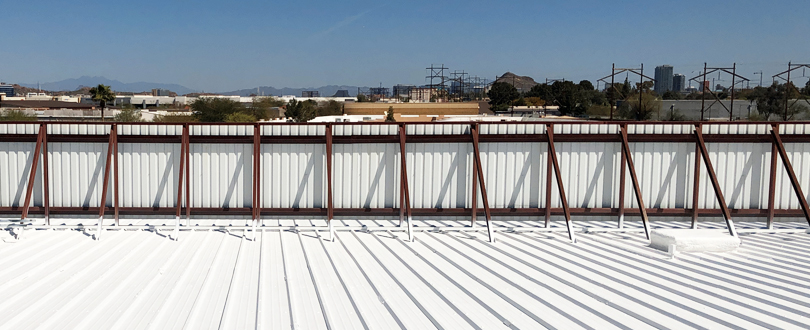
Offices, retail centers, warehouses, churches, medical buildings and multi-family properties here share a roof profile: flat or low-slope, lined with parapets, studded with HVAC units and sitting under some of the most intense sun anywhere in the country. Spray polyurethane foam topped with an elastomeric coating suits that profile well.
For an owner or manager, the appeal comes down to a few practical points. Foam is one seamless layer, so the field of the roof has no seams to open up. It adds insulation over the whole deck. It's light enough to go on many existing buildings without structural work. It can be shaped to move water. And when the surface wears, it's recoated rather than torn off, which keeps the roof in the maintenance budget instead of the capital budget more often.
It isn't the answer for every building, and we'll say so when it isn't. Our main spray foam roofing page walks through every advantage and limit in detail; this page focuses on what matters for commercial property.
HVAC curbs, penetrations and the leaks they cause
Ask any property manager where their roof leaks and the answer is usually near equipment. Rooftop units, exhaust fans, gas lines, condensate lines, conduit, plumbing vents and equipment supports all break through or sit on the roof, and on sheet-type systems each one means cutting, lapping and sealing.
Foam goes on as a liquid and expands into and around those shapes, so the details end up with far fewer seams. It can also be built up around a curb to direct water away from it. The coating follows the same contours, with reinforcing fabric and compatible sealant added at the details that need extra strength.
Details still demand skill. Curb heights, flashing, the coating thickness at each penetration and the condition of the equipment's own housing all matter. And service traffic is one of the biggest threats to a commercial foam roof, so we recommend walkway pads along the routes HVAC technicians take and ask that contractors avoid dragging tools or setting sharp equipment on the coating.
Drainage on large flat roofs
On a big flat roof, small sags add up. Water left behind by a monsoon cell wears out the coating faster, traps dirt and debris, puts extra weight on the structure and finds every weak spot. Drains and scuppers clogged with silt after a dust storm make it worse.
Foam gives you a tool most systems don't: its depth can vary across the roof, creating fall toward drains and scuppers and filling some low areas. That plan comes from surveying the roof before any spraying, and it suits many roofs but not all. Roof drains may also need attention so the new surface still flows into them properly. If some ponding can't be designed away, silicone usually handles lingering water better than most other coatings. See silicone coating over foam for how we choose coatings.
Cooling loads and top-floor comfort
A commercial roof is a large surface soaking up heat all day. Each inch of closed-cell foam provides around R-6 to R-7, depending on the product, in one continuous layer over the deck, and it cuts the air that leaks through the roof assembly. A white reflective coating on top sends much of the sun's energy back off the roof before it becomes heat.
Combined, they can trim peak cooling loads, slow heat flow indoors and make top-floor suites, upper apartments and warehouse floors more comfortable. Real results vary with the insulation already there, how the building is used, air leakage elsewhere in the envelope, the HVAC equipment and how well the coating is kept clean. Energy savings need to be estimated for your specific building, and we don't promise a fixed percentage.
Keeping tenants, customers and operations running
On a commercial job, the roof is only part of the project. The rest is the people under it. Foam and coating projects can be easier on a building than a full tear-off: less demolition, fewer dumpsters, less debris near entrances and often a shorter schedule.
Spraying does bring its own coordination needs, and we plan them with you before work starts:
- Air intakes. Rooftop units and fresh-air intakes near the work may need to be shut down or protected so odor and overspray don't get drawn inside.
- Wind. Foam is sprayed only when wind conditions allow, which protects cars, neighboring buildings and the work itself.
- Access and staging. We confirm how we'll reach the roof and where equipment will sit so entrances, parking and deliveries keep moving.
- Notice. Letting tenants know the schedule ahead of time prevents most complaints.
- Weather. Coatings need dry weather, so monsoon storms shape the calendar and we'll keep you posted if dates move.
Restoring the roof you have instead of tearing it off
If your building already has a built-up, modified bitumen, single-ply or older foam roof, it may not need to come off. A roof that is still sound and dry can often be restored in one of two ways.
Coating restoration
We clean and repair the existing roof, prime it where required and coat it, usually with silicone. You get a renewed waterproof, reflective surface with relatively little disruption. It doesn't add meaningful insulation or change the roof's slope.
New foam over the existing roof
After prep, closed-cell foam goes directly over the old roof and is then coated. You get added insulation, a seamless new surface and the chance to correct drainage, without the demolition.
Neither option works when the insulation is soaked, moisture is sealed inside, the deck has deteriorated or the materials aren't compatible. That's why we check for moisture before recommending either. Our foam roof recoating page explains how we tell a restorable roof from one that has to come off.
Building a maintenance program
Foam roofs earn their long service life through maintenance, and commercial roofs do best on a written program rather than reacting to leak calls. The table on this page lays out what a typical program includes and why each piece matters.
A program also gives you something a reactive approach can't: a paper trail. Inspection reports, photos, repair records and recoat dates help with budgeting, support warranty requirements and give the next manager or buyer a clear picture of the roof. On larger roofs, recoats can be phased section by section, provided nothing is left exposed in the meantime.
Warranty questions owners and managers should ask
On a commercial roof, warranty details matter more than the headline number of years. The terms turn on the product maker, the specified system, foam and coating thickness, who did the installation and whether required maintenance was kept up. When we propose a system, we explain the warranty that comes with it. Whoever you work with, get written answers to these:
- Which company stands behind the roof, the product maker, the roofing contractor or the two together?
- Are both labor and materials covered if something fails?
- Does coverage include workmanship problems, not just product defects?
- Is damage from ponding water excluded?
- What inspection and maintenance records must we keep for the warranty to stay in force?
- Do future recoats have to be done by an approved applicator?
- Does the coverage transfer if the building is sold?
Planning the roof budget over the building's life
Foam can be a cost-effective commercial roof over time because of possible energy savings, local repairs, less demolition and recoats in place of replacement. Whether it works out that way depends on the initial installation, the maintenance program and the roof's starting condition.
For capital planning, the useful approach is to treat the roof as a cycle: installation or restoration, annual inspections and small repairs, then a recoat when the coating thins. Knowing roughly when each recoat is due lets you budget for it years ahead. We don't publish prices because every roof is different; the Roofing Cost Guide explains what drives cost.
Starting a commercial foam project with us
Every commercial project starts with a paid inspection. We look at the roof surface, coating, foam or existing system, moisture, drainage, flashing and equipment, photograph what we find and give you a written estimate with our recommendation. Financing is available; ask during the estimate.
Integrity Roofing is a family business that has operated since 1993 and has completed more than 2,500 projects. We're licensed, bonded and insured, Arizona ROC #096629. Call our Gilbert office at 602-548-3770 between 7 am and 5 pm, Monday to Friday, or email office.integrityroofing@gmail.com. If we don't answer, leave a message and we'll return your call within 24 hours. See our full commercial roofing services as well.
A commercial foam roof maintenance program
A typical framework. The right schedule depends on the roof, the coating and any warranty requirements.
| Task | When | Why it matters |
|---|---|---|
| Full roof inspection | Spring and fall | Catches thin coating, punctures and flashing issues while repairs are small |
| Post-storm check | After hail, severe monsoon storms or dust storms | Finds impact damage, debris and clogged drains quickly |
| Drain and scupper cleaning | Ahead of monsoon season and after each dust storm | Keeps water moving so it doesn't pond and wear the coating |
| Penetration and curb review | At every inspection | Equipment areas are where most commercial leaks start |
| Local repairs | As soon as damage is found | Keeps water and UV out of the foam |
| Walkway pad check | At every inspection | Protects the coating along technician routes |
| Recoat planning | Several years ahead of the expected recoat | Allows budgeting and phased recoats by section |
| Record keeping | Ongoing | Supports warranty requirements, budgeting and future sales |
Related services

Spray Foam Roofing
Our featured system: seamless, insulating, renewable roofs.
Learn more
Foam Roof Recoating
Warning signs, repairs and recoating for foam roofs.
Learn more
Silicone Over Foam
Silicone vs acrylic vs polyurethane over foam.
Learn more
Commercial Roofing
Flat roofs, foam, coatings and maintenance for businesses.
Learn moreFrequently asked questions
Still have a question? Call the office at 602-548-3770, Monday to Friday, 7 am to 5 pm.
What information should a property manager have ready before a foam roof inspection?
Have the building address, roof access details, approximate roof size, any history of leaks with their locations and any records of past roof work or coatings. Contact information for whoever will meet us on site helps too. The more we know about the roof's history, the more useful the inspection is.
Who should be told before foam is sprayed on an occupied building?
Tenants, building staff and anyone who services rooftop equipment should know the schedule. Occupants near air intakes should expect some units to be turned off while we work nearby. Clear notice ahead of time prevents most complaints and surprises.
Can rooftop HVAC units stay in place during a foam roof project?
In most cases, yes. The foam and coating are applied around the curbs and supports rather than requiring units to be removed. Units near the work may need to be shut down for a while to keep odor and overspray out of the air intakes.
How does a foam roof affect a building's roof drains and scuppers?
Adding foam raises the roof surface, so drains and scuppers have to be detailed so water still flows into them without backing up. Done well, tapered foam can actually improve how water reaches them. This is planned during the design, not left for the crew to figure out on the roof.
Is a foam roof suitable for a restaurant with kitchen exhaust on the roof?
It can be, but grease and exhaust residue are hard on many coatings. The coating needs to be chosen for that exposure, and the area around the exhaust fan needs regular cleaning and inspection. Grease containment at the fan is also important.
Can foam be installed on a multi-family or HOA building?
Yes. Apartment, condo and HOA properties with low-slope or flat roofs often make good candidates. The main extra steps are coordinating with the board or management, giving residents notice and planning around shared air intakes and parking.
How do maintenance records help with a foam roof warranty?
Many warranties require documented inspections and maintenance to stay in force. Records of inspections, repairs and recoats show the roof has been cared for as required. They also help budget for the next recoat and answer questions if the building is sold.
Can a foam roof be part of a long-term capital plan?
Yes, and it fits well because the cycle is predictable: installation or restoration, regular inspections and repairs, then periodic recoats. Knowing roughly when each recoat is due lets owners spread costs over time instead of facing a sudden full replacement.
Should a commercial roof be checked for moisture before foam goes over it?
Always. Spraying foam or a restoration coating over wet insulation traps the moisture and leads to early failure. Moisture checks identify wet areas so they can be removed and replaced before the new system goes on.
Let's take a look at your roof.
Call the office at 602-548-3770 to schedule an estimate, Monday to Friday, 7 am to 5 pm. If we don't answer, leave a message and we'll return your call within 24 hours.