
Spray foam roofing in the Phoenix Valley
Of all the roofs we work on, spray polyurethane foam gets the most attention on this site, because few systems answer Arizona's sun, monsoon rain and flat rooflines as well. Here is everything it does, what the coating on top adds, and where the limits are.
Last updated
The short answer
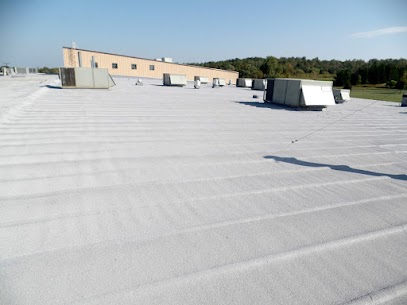
A spray foam roof is closed-cell polyurethane sprayed onto the roof as a liquid, where it expands into one seamless, insulating layer that is then sealed under an elastomeric coating. The foam insulates and sheds water, while the coating blocks UV, reflects heat and can be renewed again and again. Kept coated and inspected, a foam roof can stay in service for decades.
What you're actually buying: two layers with two jobs
A spray foam roof starts as two liquid chemicals that meet at the tip of a spray gun. Within seconds of hitting the roof, the mix swells into rigid, closed-cell polyurethane that grips the surface beneath it. Pass by pass, the crew builds a single continuous layer that insulates the building and sheds water, with no rolls, sheets or overlapping seams across the open roof.
That foam is only half the roof. Polyurethane can't survive direct sunlight, so every foam roof is sealed under an elastomeric coating, a thick, rubbery liquid that cures into a flexible skin. Picture the foam as the roof's insulating core and the coating as its sunscreen and raincoat rolled into one. One without the other isn't a finished roof.
We feature foam more than any other topic on this site because it suits the Valley so well: flat and low-slope roofs, relentless UV, sudden monsoon downpours and rooftops crowded with AC units and coolers. Below we walk through every advantage of the foam, every advantage of the coating over it, and the honest caveats attached to each. If you'd like the basics of foam installation and repair first, our foam roofing overview covers them.
The golden rule: foam never faces the sun alone
If you remember one thing about foam roofs, make it this: bare foam and sunlight don't mix. Ultraviolet light attacks polyurethane. Left uncovered, the surface yellows, then darkens toward rust or brown, turns chalky and crumbly, and slowly wears thinner. Under Arizona sun, that damage starts quickly.
The coating is what stops it. As long as an unbroken layer of coating sits over the foam at the thickness the manufacturer calls for, the foam underneath stays protected and keeps insulating. That's why the rest of this page treats foam and coating as a team, and why most of the long-term care of a foam roof is really care of its coating.
Comfort and energy: what you feel in the rooms below
These four advantages work together to keep summer heat up on the roof instead of inside the house or building.
Foam advantage: a thick, continuous blanket of insulation
Depending on the product, each inch of closed-cell roofing foam is worth roughly R-6 to R-7, and the layer runs edge to edge across the deck with no gaps between boards. That slows heat moving down into the building on summer afternoons and holds warmth in on winter nights. Rooms under the roof tend to keep a steadier temperature, and the air conditioner may not have to work as hard. The size of the change you feel hinges on the insulation already in place, air leakage, how the space is used, the climate and the HVAC equipment.
Foam advantage: fewer air leaks through the roof
Because closed-cell foam is sprayed on and bonds to the deck, it seals gaps and cracks that would otherwise let air slip in and out through the roof assembly. Less leakage can mean fewer drafts, more even comfort and a more efficient HVAC system. The roof is only one piece of the building envelope, though. Leaky windows, doors, walls or ductwork still matter, so the full benefit depends on the whole building.
Coating advantage: sunlight bounced back toward the sky
A white or other highly reflective coating sends much of the sun's energy back off the roof before it can turn into heat. The surface runs cooler, and less heat soaks into the foam and the rooms below. How much it helps comes down to the product's reflectance and emittance ratings, whether the surface stays clean and what insulation lies below.
Foam and coating together: better whole-building energy performance
Stack insulation, air sealing and a reflective surface, and the roof can trim peak cooling demand, slow heat flow through the ceiling and make the spaces under it more comfortable. What it can't do is guarantee a set percentage off your power bill. Every building responds differently, so savings have to be estimated for your building in particular, and we won't quote a number we can't back up.
Keeping water out: seams, details and drainage
Leaks are the reason most people call a roofer. Six of the system's advantages are about keeping water where it belongs.
Foam advantage: one piece, no seams
Most flat roofs that leak do it at a seam, a lap or a fastener. Foam is sprayed in place as one continuous layer. The open roof has no sheet laps at all, water has far fewer joints to find, and few if any fasteners need to punch through. It wraps without a break around penetrations and odd shapes. The caveat: foam is not the whole waterproofing system by itself. It counts on a compatible coating over it to finish the job.
Foam advantage: it surrounds rooftop equipment instead of being cut around it
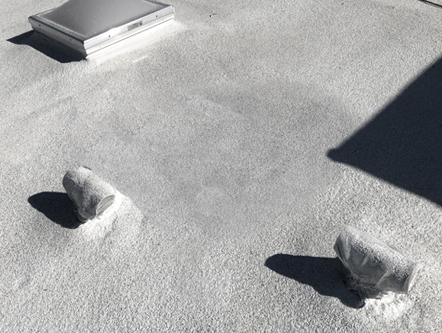
AC curbs, evaporative coolers, vent stacks, plumbing pipes, conduit and equipment stands are where conventional roofs get cut, patched and lapped, and that's where they tend to leak. Foam is sprayed into and around those shapes, so the details have fewer seams, and it can be built up to tilt water away from equipment. Those spots still need careful flashing and coating work. Foam makes good details easier; it doesn't replace them.
Foam advantage: slope built into the roof itself
Foam doesn't have to go on at one even thickness. By varying the depth from one area to the next, the crew creates fall toward drains and scuppers, fills some low spots and cuts down on ponding where the roof allows it. That has to be laid out from a survey of the roof's high points, low points and drains before spraying starts. And no coating, however good, will cure a serious drainage problem on its own.
Coating advantage: a second waterproof layer
The coating cures into an unbroken film on top of the foam and fills minor pinholes and surface texture, so water has two layers to get through instead of one. It isn't a cure-all. A coating can't dry out wet foam, close major cracks, rescue failed flashing or fix poor drainage. Those get repaired first.
Coating advantage: rain and standing water kept off the foam
Applied properly, the coating keeps monsoon rain and lingering water from reaching the foam. How well it does that comes down to four things: the right thickness, proper surface prep, sound flashing details and a roof that drains.
Coating advantage: it follows every curb, pipe and transition
Applied wet, the coating flows around pipes, vents, curbs and flashing transitions that sheet materials struggle with. Where a detail needs extra strength, reinforcing fabric and compatible sealants are embedded in the coating.
Standing up to heat, storms and wear
Arizona is hard on any roof. These eight advantages are about how the foam and coating hold up to it.
Coating advantage: UV protection, its most important job
Everything else the coating does comes second to this. Foam left unprotected changes color, gets brittle and powdery, and erodes a little more each year. The coating takes the UV punishment so the foam doesn't, which is why an intact coating at full thickness is non-negotiable on an Arizona roof.
Coating advantage: less weathering of the whole system
Sunlight, moisture and the daily swing between scorching afternoons and cooler nights all wear on a roof. The coating takes that abuse first, slowing the deterioration of the foam and everything beneath it.
Coating advantage: it stretches and recovers
Elastomeric coatings flex as the roof grows in the afternoon heat and shrinks back overnight, and they can span hairline cracks in the surface. They can't bridge real structural movement, such as a working expansion joint, unless that spot is specially detailed.
Foam advantage: built for everyday roof stresses
The closed-cell foam made for roofing resists crushing well enough for a roof surface, takes on much less water than open-cell foam does, and keeps its shape and size as temperatures swing. It's tough, not indestructible. It can still be hurt by hard impacts, careless or heavy foot traffic, certain chemicals and sunlight reaching it through worn coating.
Foam advantage: strong resistance to wind uplift
Foam bonds fully to what's beneath it and has very few seams or loose edges, so a strong gust has little to catch and peel back. That matters when monsoon outflow winds hit. The assembly still has to meet the building code's wind requirements for your location and building.
Foam advantage: some resilience against hail and flying debris
The closed-cell structure keeps water from traveling far through the foam if the surface is punctured, and the foam offers a bit of cushion against impacts. Hail can still dent the foam and crack the coating, and wind-driven debris can puncture both. After a hailstorm or a violent monsoon cell, have the roof looked at and get damage repaired quickly.
Coating advantage: a sacrificial wear surface
The coating absorbs the abrasion, minor knocks and weathering that would otherwise grind down the foam. Standard coatings aren't made to be walked on constantly, so walkway pads belong along the routes technicians use to reach equipment.
Coating advantage: some chemical resistance
Coatings can help shield foam from equipment exhaust, airborne contaminants and drips from rooftop units. Resistance varies a lot from product to product, so the coating has to be chosen for what that particular roof is exposed to, such as a kitchen exhaust fan or process equipment.
Fitting the building you already have
Not every roof can take any system. These six advantages explain why foam fits so many buildings that other options don't.
Foam advantage: very little added weight
Foam adds only a small dead load compared with heavier roof systems. That can make it a fit for existing buildings that can't carry more weight, and it may avoid the need for structural reinforcement. Sometimes it can even be applied over the current roof instead of tearing it off, though that decision belongs to a qualified roofer who has evaluated what's already there.
Foam advantage: it bonds to many surfaces
Properly prepared concrete, wood, steel decking and some existing roof surfaces all give SPF something to grab. The bond ties the assembly together and lets foam hug surfaces that aren't flat or even. Whatever the surface, it must be clean, dry, solid and compatible, and some need a primer first for a reliable bond.
Foam advantage: it adapts to awkward roofs
Foam is at home on flat and low-slope roofs, on roofs bristling with penetrations, on irregular outlines with parapets and level changes, on restorations of suitable existing roofs and on roofs that need tapered insulation to drain. An inspection still decides whether your particular roof is a candidate.
Foam advantage: less demolition on the right roof
If the current roof checks out as sound and dry, and the materials are compatible, foam can sometimes be sprayed right over it. That means less tear-off, less debris hauled to the landfill, less noise and mess, and often a shorter job. That option is off the table when the insulation is soaked, moisture is sealed inside, the deck has rotted or deteriorated, or the existing material won't take a bond.
Coating advantage: fire performance, when the assembly is tested
Fire ratings exist for certain foam-and-coating combinations, and they apply only to the exact assembly that was tested and approved. No coating earns a roof a fire rating by itself. Requirements vary with the building and local code, so check the documentation for the specific system on each project.
Coating advantage: a clean, even look
A fresh coat gives the roof a bright, consistent appearance, which matters on roofs you can see from a second story, a neighbor's yard or an office window. Just remember that a good-looking roof isn't proof of a healthy one. Wet foam and failing details can hide under a clean surface, which is why inspections count for more than appearance.
Spending less over the life of the roof
The last nine advantages are about money and effort over the long haul, and the biggest one comes at the end.
Foam advantage: decades of service when it's cared for
Install foam correctly, keep it coated, and have it inspected and maintained, and it can stay in service for decades. The actual lifespan of any one roof hinges on several things: how good the foam is and how thick, how well it bonded, which coating protects it, how much sun and standing water it sees, how much it's walked on, how well it's been repaired and whether the manufacturer's specifications were followed. Plan on renewing the coating a few times over that span while the foam itself remains serviceable.
Foam advantage: repairs are small and local
A puncture, a blister or a gouge doesn't mean replacing a section of roof. The bad spot is cut away, refilled with fresh foam and coated again. Done right, that's far less disruptive than replacement, but the cut has to reach sound, dry foam and the materials have to be compatible, or the leak just shifts to the border of the patch.
Coating advantage: it keeps the insulation dry and working
Foam insulates best when it's dry and intact. Keeping water and UV off the foam means the insulation you paid for keeps doing its job year after year.
Coating advantage: maintenance you can actually plan
Caring for a coated foam roof follows a clear routine: keep the surface clean, keep drains and scuppers open, check penetrations, fix small damage on the spot and recoat when the coating thins. There's very little guesswork about what comes next.
Coating advantage: it stretches the life of the whole system
The foam doesn't get replaced; the coating gets renewed. The cycle is inspection, foam and flashing repairs, surface prep and a new coat at the specified thickness. That cycle keeps working as long as the foam below remains sound and dry.
Coating advantage: renewal can be phased
On a large roof, recoating can sometimes be split into stages to match a budget, starting with the most worn areas. The condition is that no section sits without protection while it waits its turn.
Coating advantage: far less waste at renewal time
When the foam is still sound, a recoat takes the place of a tear-off. That keeps a whole roof's worth of old material out of the landfill.
Foam advantage: a potentially lower cost of ownership
Possible energy savings, fewer full replacements, local repairs, less demolition and recoating instead of re-foaming can all add up over the years. Whether they do for your building depends on the original installation, the maintenance, how often it's recoated and the roof's condition today. We don't publish prices because every roof is different; our Roofing Cost Guide explains what drives the cost.
Coating advantage: a roof you renew instead of replace
This is the advantage that ties the rest together. Plenty of roof systems must be stripped off and hauled away once they're worn out. A foam roof works differently: the surface is renewed while the insulation stays, and a well-kept one can take recoat after recoat over its lifetime. That renewability is the main reason we recommend foam on so many flat roofs.
Choosing the top coat: silicone, acrylic or polyurethane
Three families of elastomeric coating are commonly applied over spray foam. Each family includes many products, and formulation matters, so the table below is a general guide, not a hard rule. The manufacturer's data for the specific product always has the final word.
Here's how we usually think about it. Silicone is our frequent choice on exposed, sun-baked flat roofs, especially where water lingers after a storm. Acrylic is a sensible, water-based option for roofs that shed water quickly and owners watching the budget. Polyurethane, in aliphatic or aromatic versions, earns its place where the roof needs extra toughness, such as regular foot traffic. For many roofs in a hot, sunny climate like ours, white silicone over closed-cell foam is an excellent pairing: it tolerates ponding, resists UV and weather, stays flexible through temperature extremes, reflects heat and is a well-recognized coating for foam. Our page on silicone coating over foam goes deeper, and the elastomeric coatings page covers coatings on other flat roofs.
Where silicone falls short
We recommend silicone often, which is exactly why we want you to know its weak spots before you choose it.
- It holds onto dust. Dirt pickup lowers reflectivity over time, and the Valley has no shortage of dust.
- Very little sticks to it. Future recoats demand careful cleaning and compatible products, which usually means more silicone.
- Some products are soft. Walkways matter wherever people regularly cross the roof.
- It doesn't fix what's underneath. Structural problems and poor drainage still have to be corrected.
- Installation makes or breaks it. Prep work, reaching full thickness, applying in dry weather and detailing carefully all decide how well it lasts.
Your roof problem, and how foam and coating answer it
Most people don't call us asking for foam. They call about a problem. Here's how the system lines up with the concerns we hear most often from homeowners and building owners.
- “Our cooling bills are brutal.” Continuous foam insulation slows heat gain, and a reflective coating keeps the surface cooler to begin with.
- “It keeps leaking.” With no seams in the foam and an unbroken coat on top, the field of the roof loses the joints where many flat-roof leaks begin.
- “There's so much equipment up there.” Sprayed foam and liquid coating fit the complex shapes around curbs, pipes and stands.
- “The surface looks tired.” An aging foam roof gets a fresh coat; the foam stays.
- “Water just sits there.” Tapered foam adds fall so water heads for the drains and scuppers.
- “We can't afford a tear-off.” A suitable existing roof may be restored instead of removed.
- “We need something we can keep up with.” Small spot repairs plus a recoat every several years keep it going.
- “The sun is wrecking it.” The coating takes the UV and weather so the foam doesn't.
A brand-new foam roof or a restored one?
People often lump these together, but they're two different projects with different results.
Installing a new foam system
New foam is sprayed onto a prepared deck, or over an existing roof that checks out sound and dry, and then coated. You gain insulation, a seamless new surface and the chance to correct drainage with tapered foam. It's the right call when you want everything foam offers, or when the current roof is past saving.
Restoring an existing roof with a coating
A sound, dry commercial roof, whether built-up, modified bitumen, single-ply or older foam, can often get a second life from a silicone coating system. The crew cleans it, repairs it, primes it if needed and coats it. It renews the waterproofing and reflectivity, but it adds little insulation and doesn't change the roof's slope.
The right path depends on how much moisture the old roof holds, the deck's condition, drainage, how much insulation you want and budget. On an existing foam roof, renewing the coating is usually the first question to answer; our foam roof recoating page explains how we decide.
What Arizona throws at a foam roof
Our climate is the reason foam and reflective coatings are so common here, and also the reason installation quality and upkeep matter so much.
- Heat and UV, nearly every day. The desert sun is what wears coatings down and why foam can never be left bare. A bright, reflective top coat pushes back against summer heat gain.
- Monsoon season, June 15–September 30. Storms arrive fast with heavy rain, gusty outflow winds and blowing debris, testing drainage, flashing and any weak spot in the coating. Foam and coatings won't bond or cure properly on a wet surface, so we plan work around the storm pattern.
- Dust storms. A haboob can leave a film of dirt across the roof and pack drains and scuppers with silt. That dulls reflectivity and can turn a light rain into ponding, so drains are worth checking after a big one.
- Hail. It isn't frequent here, but it happens. Hail can dent foam and fracture the coating, so have the roof looked over afterward.
- Ponding. Flat roofs that hold water wear out their coating fastest in those spots. Tapered foam improves drainage, and silicone handles standing water better than many coatings.
Our storm damage page covers what to do after a severe monsoon storm.
Foam on Valley homes
Spray foam isn't just for warehouses. Plenty of houses across the Valley have flat or low-slope roof areas where foam is often the strongest option.
- Pueblo Revival and territorial-style homes with flat roofs ringed by parapet walls, where water has to reach a scupper to leave.
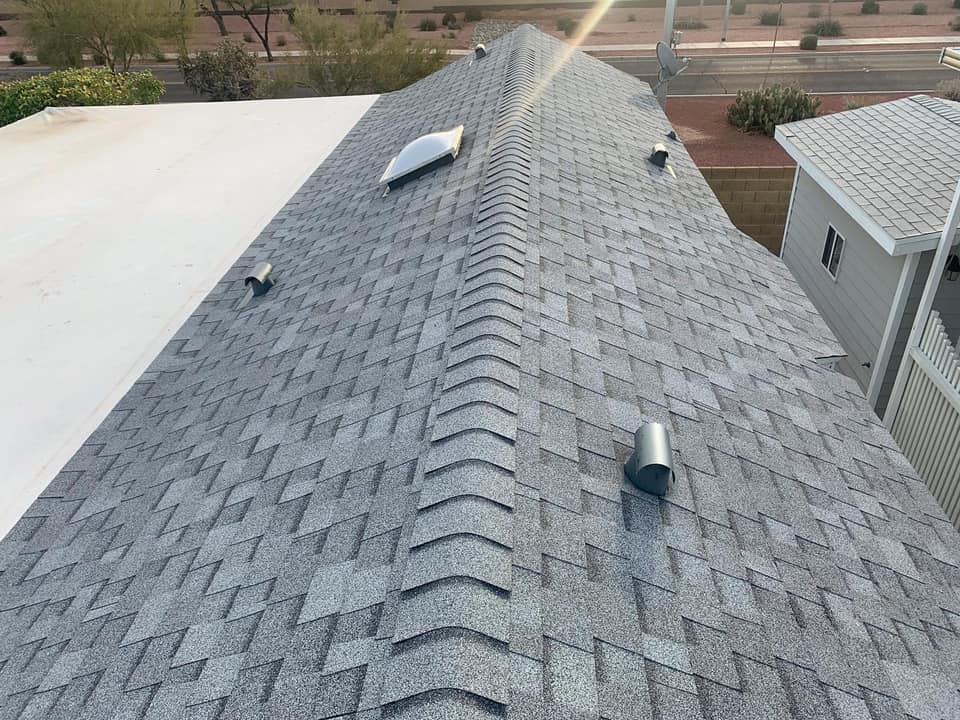
- Flat additions and Arizona rooms tied into a pitched tile or shingle main roof. That tie-in joint needs careful detailing.
- Patio covers and carports with very little slope, which are prone to ponding.
- Roofs carrying an AC unit or evaporative cooler, where the foam can wrap the curb and the cooler's drip area.
For a homeowner, that adds up to a seamless roof over living space, extra insulation right where the heat comes in, a cooler surface and a roof you renew rather than replace. If you're in an HOA, ask whether there are rules about roof color or what's visible from the street before work begins. And please keep your own checks to the ground or a window with a view. A slip on a roof isn't worth the risk, and a professional roof inspection is the safer way to see it up close. See residential roofing for everything else we do for homes.
Foam on commercial buildings
Offices, retail centers, warehouses, churches and multi-family buildings in the Valley are mostly flat-roofed and loaded with HVAC equipment. That's where foam's seamless details, tapered drainage, light weight and renewable surface pay off most, and where a restoration over the existing roof can spare tenants the noise and debris of a tear-off.
Our commercial spray foam roofing page is written for owners and property managers, and our broader commercial roofing services page covers everything else we do on commercial roofs.
How long a foam roof lasts, and what to ask about the warranty
According to the Spray Polyurethane Foam Alliance (SPFA), the industry's trade association, foam roofs that get regular inspections and timely recoats can keep working for decades. In real life, the foam usually outlives its first coating. That's expected; the recoat is part of the design, not a sign of failure.
Warranties on foam systems vary widely. Coverage hinges on who made the products, which system was specified, how thick the foam and coating are, who installed it and whether the required maintenance gets done. Manufacturer system warranties come in different lengths depending on the system, but never assume a length or what's covered. When we propose a system, we explain the warranty that comes with it so you know who stands behind what. Before you sign anything, from us or anyone else, get clear answers to these questions:
- Is the warranty from the manufacturer, the installing contractor, or each of them?
- Does it pay for labor, materials or both?
- Are installation mistakes covered, or only defective products?
- Does it exclude damage from ponding water?
- What inspections or maintenance must be done, and documented, to keep it valid?
- Do future recoats have to be performed by an approved contractor?
- If you sell the property, does the coverage pass to the buyer?
The foam system we recommend
When a roof is a good candidate for new foam, the system we recommend has five parts, shown in the steps below. Each one leans on the others. Skip any of them and the rest suffer: a skimpy coat lets the sun into good foam, and the best coating made won't save foam that went down over a wet surface.
How we handle a foam project, start to finish
- Paid inspection. Our roof inspections are a paid service. On a foam roof we check coating wear and thickness, foam condition and adhesion, signs of moisture, the deck, drainage, flashing and rooftop equipment, and we photograph what we find.
- A straight recommendation. We explain whether repairs, a recoat, a restoration, new foam or another system entirely makes the most sense, and why.
- Written estimate. You get a written estimate describing the scope of work. Financing is available; ask about it during the estimate.
- Scheduling around the weather. Spraying and coating wait for dry surfaces and the right temperatures. We work around monsoon storms and arrange roof access with you, your HOA or your tenants.
- Prep and installation. The surface is cleaned and repaired, foam and coating go on at the thicknesses specified, and every penetration, drain and flashing gets detailed.
- Walkthrough and care plan. We go over the completed roof together and suggest a schedule for inspections and the next recoat.
Integrity Roofing is a family-owned company that has served the Valley since 1993. We're licensed, bonded and insured, Arizona ROC #096629. We work on foam roofs in Gilbert, Mesa, Chandler, Queen Creek, San Tan Valley, Tempe, Phoenix, Scottsdale, Apache Junction, Ahwatukee, Glendale and Peoria. Call 602-548-3770 between 7 am and 5 pm, Monday to Friday, or email office.integrityroofing@gmail.com. If we don't answer, leave a message and we'll return your call within 24 hours.
What's included
Cooler rooms below
Continuous foam insulation and a white, reflective top coat cut the heat moving through the roof.
No seams to fail
Foam goes on in one piece, so the open field of the roof has no laps or seams for water to pry open.
Slope where you need it
Foam can be built up thicker in spots to steer water toward drains and scuppers.
Light on the structure
It adds very little weight, and on a suitable roof it can go over the existing surface.
Fixable in small pieces
Damage is cut out, re-foamed and recoated locally instead of replacing a whole section.
Renew it, don't tear it off
When the coating wears, it gets recoated. The insulating foam underneath stays put.
What to expect
- 1
Start with a sound, clean substrate
The deck or existing roof is cleaned, dried, repaired and primed where needed so the foam bonds to something solid and compatible.
- 2
Spray closed-cell foam to the specified thickness
Foam is applied for insulation value and, where the survey calls for it, built thicker to create slope toward drains and scuppers.
- 3
Top it with compatible white silicone
A silicone elastomeric coating goes on at the specified thickness to block UV, shed water and reflect heat.
- 4
Detail every penetration, drain and walkway
Curbs, pipes, drains, scuppers and flashing get reinforced detailing, and walkway pads go where technicians travel.
- 5
Put the care plan in writing
A written inspection and maintenance program spells out when the roof is checked, how repairs are handled and when recoats are due.
Coatings commonly used over spray foam
General guidance only. Performance depends on the specific product and formulation, so manufacturer data comes first.
| Coating | Strengths | Watch-outs | Cleanup and recoating | Usually fits |
|---|---|---|---|---|
| Silicone | Excellent UV resistance; generally excellent under ponding water; excellent reflectivity when new and white | Picks up dirt, which dulls reflectivity; abrasion resistance varies and some products are soft | Generally solvent cleanup; recoats need compatible prep and materials, often silicone over silicone | Exposed roofs, especially those with ponding concerns |
| Acrylic | Generally good UV resistance; excellent reflectivity when new and white | Often limited under prolonged ponding | Water-based cleanup | Roofs that drain quickly, when budget is a priority |
| Polyurethane (aliphatic or aromatic) | Some formulations are very tough and abrasion resistant | Performance depends heavily on the formulation | Follow the specific product's requirements | Roofs that need extra toughness or see foot traffic |
Related services
Silicone Over Foam
Silicone vs acrylic vs polyurethane over foam.
Learn moreFoam Roof Recoating
Warning signs, repairs and recoating for foam roofs.
Learn more
Commercial Spray Foam
Foam roofing for offices, retail and multi-family buildings.
Learn more
Commercial Roofing
Flat roofs, foam, coatings and maintenance for businesses.
Learn moreFrequently asked questions
Still have a question? Call the office at 602-548-3770, Monday to Friday, 7 am to 5 pm.
Is a spray foam roof considered a cool roof?
A foam roof finished with a bright white, reflective coating works as a cool roof, since most of the sunlight hitting it bounces away rather than turning into heat. Unlike a coating alone, it also adds a continuous layer of insulation underneath. Bear in mind that dust gradually dulls the surface, and a cleaner roof stays cooler.
Why does Integrity Roofing feature spray foam more than other flat roof systems?
Foam fits the conditions Valley roofs face: intense UV, flat and low-slope rooflines, crowded rooftop equipment and sudden monsoon rain. It insulates, has no field seams, can be shaped for drainage and renews with a recoat instead of a tear-off. It isn't right for every roof, and an inspection decides that.
Can foam be sprayed on just one flat section of my house?
Yes. Many homes have foam only on a flat addition, Arizona room or patio cover while the main roof is tile or shingle. The important part is the joint where the flat section meets the pitched roof, which needs careful flashing so water from the main roof doesn't get behind the foam.
Is spray foam a good fit for a pueblo-style home with parapet walls?
Often it is. Foam can run up the inside of parapet walls, wrap around scuppers and be tapered so water moves toward the exits instead of collecting along the walls. Parapet caps and stucco still need to be in good shape, because water that gets in at the top of a wall can bypass the roof entirely.
Does closed-cell foam soak up water if the coating gets punctured?
Closed-cell foam takes on much less water than the open-cell kind, and its sealed cells limit how far water travels from a puncture. It isn't immune, though. Water left to work into a damaged spot can wet the surrounding foam, so punctures should be repaired promptly.
Which layer of a foam roof actually keeps the rain out?
Both layers share the job. The foam is a seamless, water-shedding body, and the coating adds a continuous waterproof film while protecting the foam from UV. If the coating wears through, the foam is exposed to sun and water, which is why recoating on schedule matters.
Why does roof weight matter when choosing a flat roof system?
Every roof system adds dead load that the structure has to carry. Some older buildings, patio covers and additions weren't built with much extra capacity, which limits the heavier options. Foam adds very little weight, which is one reason it fits so many existing structures.
Can foam go over an old tar and gravel roof?
Sometimes. Loose gravel generally has to be removed and the surface cleaned, and the old roof must be dry, sound and compatible with foam. If moisture is trapped in the old layers or the deck is damaged, that material has to come off first.
How is a foam roof different from a modified bitumen roof?
Modified bitumen is installed in rolls with overlapping seams, while foam is sprayed as one seamless layer that also adds insulation and can be tapered for drainage. Modified bitumen handles foot traffic well and is common on commercial roofs. Foam is renewed with a recoat rather than new sheets, so which one wins depends on the building and how the roof gets used.
What details should I compare between two foam roof proposals?
Compare the foam thickness, whether tapering for drainage is included, the coating type and specified thickness, how wet or damaged areas will be handled and how penetrations and walkways will be detailed. Also compare whose warranty applies and what maintenance it requires. A lower number that leaves out prep or thickness isn't the same roof.
Is there a charge for a foam roof inspection?
Yes. Roof inspections are a paid service at Integrity Roofing. On a foam roof we check coating thickness and wear, foam condition, moisture, drainage, flashing and equipment, then explain what we found and what we recommend.
What is the most common reason foam roofs fail early?
Letting the coating wear through is the biggest one. Once UV reaches bare foam, the surface breaks down and water follows. Thin original coatings, ponding that goes unaddressed and poorly detailed penetrations are the other usual causes.
Can a foam roof warranty transfer to the next owner?
Some can and some can't, and transfers sometimes require notice, an inspection or a fee set by the warranty issuer. Read the actual warranty document and ask before you buy or sell. When we propose a system, we explain the warranty that comes with it, including whether it transfers.
Will a foam roof help with a hot Arizona room or patio enclosure?
It can help, because many of these rooms sit under a thin, poorly insulated flat roof. Foam adds continuous insulation and a reflective surface right over the space. Single-pane windows and walls also let heat in, so results depend on the whole room.
Does a foam roof need different attention in summer than in winter?
Summer brings the most UV and the monsoon, so drains, scuppers and the coating deserve a close look before and after storm season. Winter is milder on the roof, but dew and occasional rain matter for scheduling coating work. Inspections before and after monsoon season cover both.
How do I start a foam roofing project with Integrity Roofing?
Call 602-548-3770 between 7 am and 5 pm, Monday to Friday, or email office.integrityroofing@gmail.com. We'll schedule a paid inspection, explain your options and give you a written estimate, and financing is available. If we don't answer, leave a message and we'll return your call within 24 hours.
Let's take a look at your roof.
Call the office at 602-548-3770 to schedule an estimate, Monday to Friday, 7 am to 5 pm. If we don't answer, leave a message and we'll return your call within 24 hours.